CLIENT:
TIM by Stocci
YEAR:
2025
SERVICE
Product Engineer
Tim - Marketing Insights Hub
about.
Picture an ocean of data. On the surface, waves bring news about competitors, regulatory shifts, and emerging market trends. Beneath, stronger currents carry the murmur of customers across social media, their complaints, their unmet needs, their quiet requests for better service. And deep down, resting on the ocean floor, lie the hidden treasures of TIM's own internal data: NPS scores, support call logs, usage patterns. A treasure map no one had time to read.
For too long, TIM's marketing strategists navigated this ocean with broken compasses. They relied on spreadsheets as maps and intuition as their guiding star. The process was slow, manual, and fundamentally reactive. By the time they connected the dots, the market had already drawn a new constellation. Opportunities appeared on the horizon and vanished just as quickly, often before a single campaign email could be drafted.
We proposed a new vessel.
The TIM Marketing Insights Hub is more than a platform. It is a command center for this new kind of navigation. We built an AI powered ecosystem designed to transform that chaotic ocean of data into a living, breathing map one that updates in real time and points directly toward action.
my role.
I acted as a Product Engineer, working directly with stakeholders in a cross-functional capacity. My responsibilities spanned the entire discovery and validation phase:
Conducting user and market discovery sessions with the client.
Defining product features and mapping user flows.
Designing the solution’s structure, wireframes, and high-fidelity screens.
Validating concepts and testing with end-users.
Developing a high-fidelity, navigable MVP prototype using vibe coding tools (Lovable) to simulate a final front-end experience for client validation.
challenge.
The core challenge stemmed from a fundamental inefficiency in how TIM's marketing professionals identified and acted upon market opportunities. The existing workflow was not just slow; it was a fragile, multi-step process that was heavily reliant on manual effort and prone to delays, ultimately impacting the company's ability to be agile in a competitive telecommunications market.
The Manual Reality of the "Old Way"
A typical cycle for a marketing strategist at TIM involved a laborious, multi-day process:
Fragmented Data Discovery: The journey would begin with a broad, undefined goal like "find trends in customer complaints about mobile data." The strategist would then have to manually navigate a disparate set of sources:
Public News: Scouring telecom news sites (like TeleSíntese or Mobile Time) for regulatory changes or competitor moves.
Social Listening: Manually searching on X (formerly Twitter) and Reclame Aqui for customer sentiment and specific service complaints (e.g., "5G signal drop in Zona Sul").
Internal Data Silos: Exporting spreadsheets from internal NPS surveys and post-sales support calls, which were stored in separate, unconnected databases.
Manual Curation & Structuring: Once this raw data was collected from its various sources, the professional would spend hours in spreadsheets, cleaning, tagging, and trying to structure it. This step was not only tedious but also introduced human error and bias. For example, a complaint about "internet speed" in Rio de Janeiro might be manually tagged under "Technical Issues - Region," but a similar complaint could be miscategorized, leading to fragmented insights.
Subjective Insight Extraction: With the data (partially) structured, the strategist would then try to connect the dots. This was a highly subjective process. They would look for patterns, but without advanced analytical tools, they might miss subtle correlations, such as a spike in social media complaints about "billing errors" occurring just after a new price plan was launched.
Delayed Action & Missed Opportunities: Finally, an insight would be generated (e.g., "There's growing demand for flexible, short-term data plans among young adults in São Paulo"). A campaign would then be designed and approved. However, this entire cycle—from initial search to campaign launch—could take one to two weeks. In the fast-paced digital marketing landscape, this delay was critical. A trend spotted on Monday could be mainstream by Friday, and a competitor could have already launched a campaign to capture that audience. The company was constantly reacting to the market, rather than proactively shaping it.
The Deeper Problem: Fragmented Intelligence
The fundamental issue was that TIM's market intelligence was scattered. There was no single source of truth. The valuable signals hidden in news articles, social conversations, and internal metrics remained siloed. This fragmentation meant that:
The company was slow to react to negative sentiment spikes or emerging competitor threats.
Marketing campaigns were often based on historical data rather than real-time trends, reducing their potential impact.
The process was demotivating for talent: Highly skilled marketing professionals were spending the bulk of their time on manual data entry and spreadsheet management, rather than on the strategic, creative work they were hired to do.
The challenge, therefore, was not just to build a tool, but to fundamentally redesign the intelligence-gathering process. We needed to move from a reactive, manual, and fragmented model to a proactive, automated, and unified system that could deliver actionable insights in near real-time, empowering TIM's marketers to make faster, data-backed decisions and seize opportunities before they vanished.
approach.
To address this, we proposed building a centralized insights hub. My approach was structured in three key phases:
Discovery & Definition: I worked with stakeholders to map all relevant data sources. These included public news APIs for market trends, social media platforms for sentiment analysis and service requests, and internal TIM data like post-sales NPS metrics. This phase defined the scope of what needed to be monitored.
Solution Architecture & Design: The core idea was to create a pipeline that crawls, aggregates, and structures this disparate data. A Large Language Model (LLM) then analyzes the unified dataset to identify patterns, group relevant information, and classify priorities.
UX/UI Design: Using Figma, I established the platform’s visual language, aligning it with TIM’s existing design system. I then created the sitemap, user flows, and initial wireframes for the three main pillars of the platform:
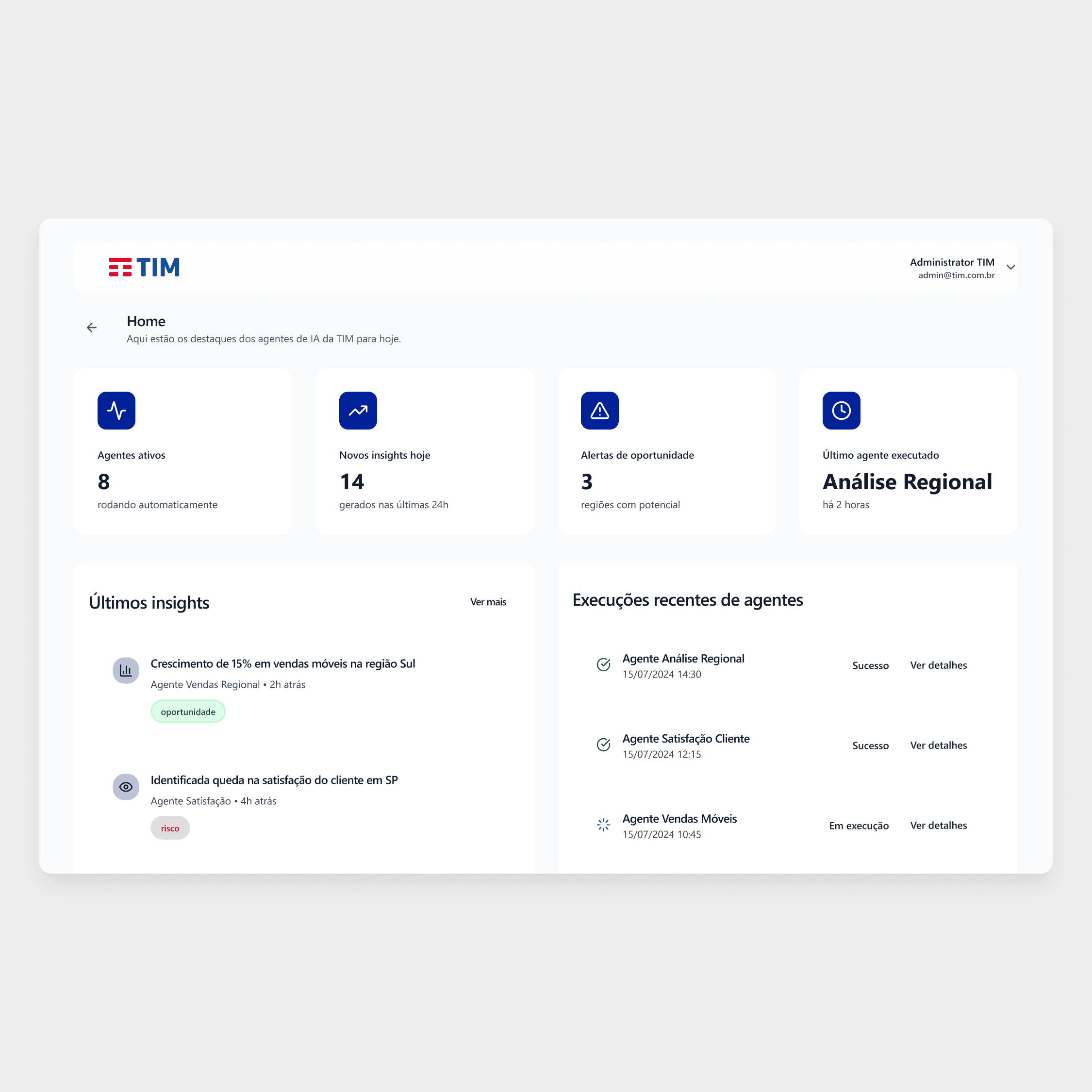
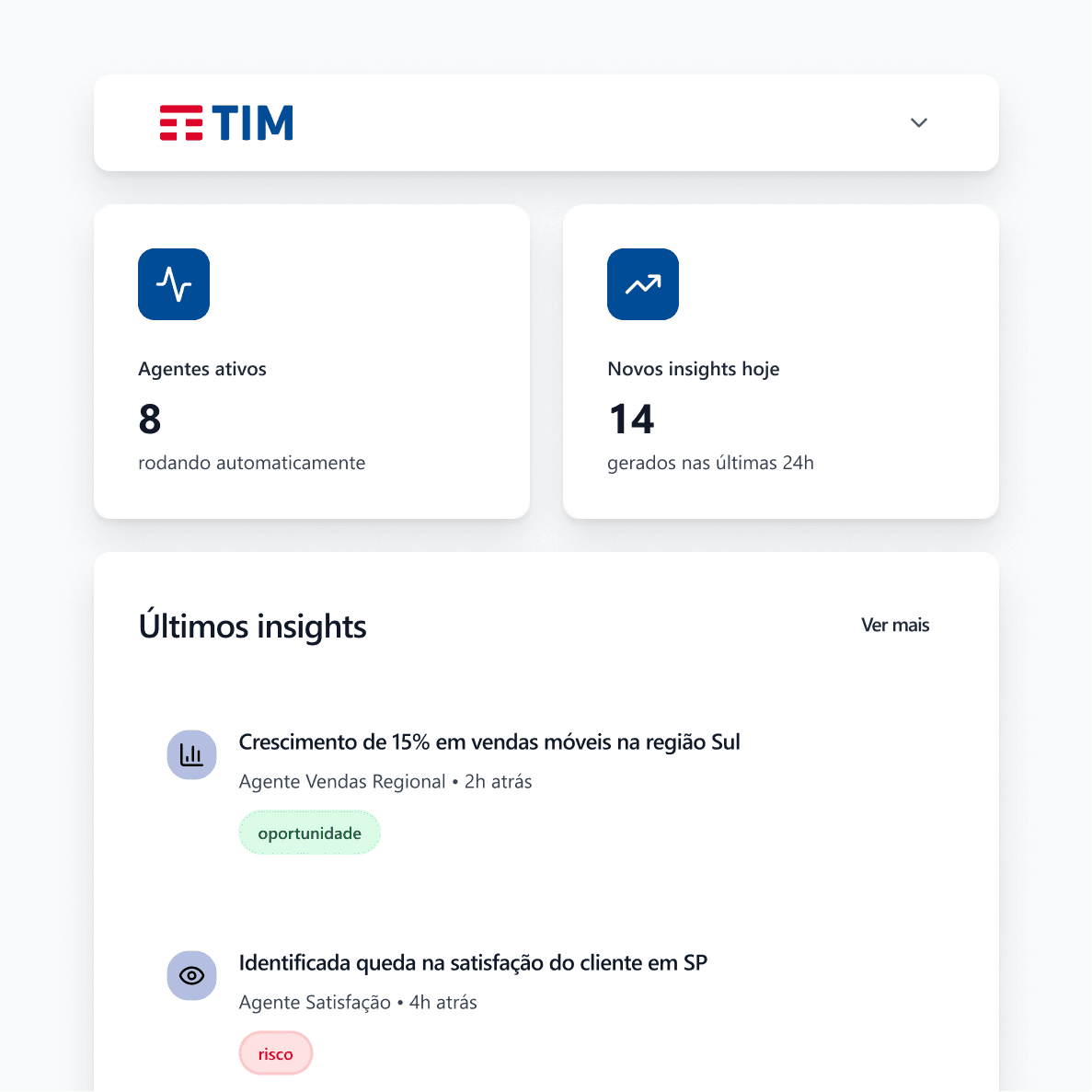
A real-time monitoring dashboard.
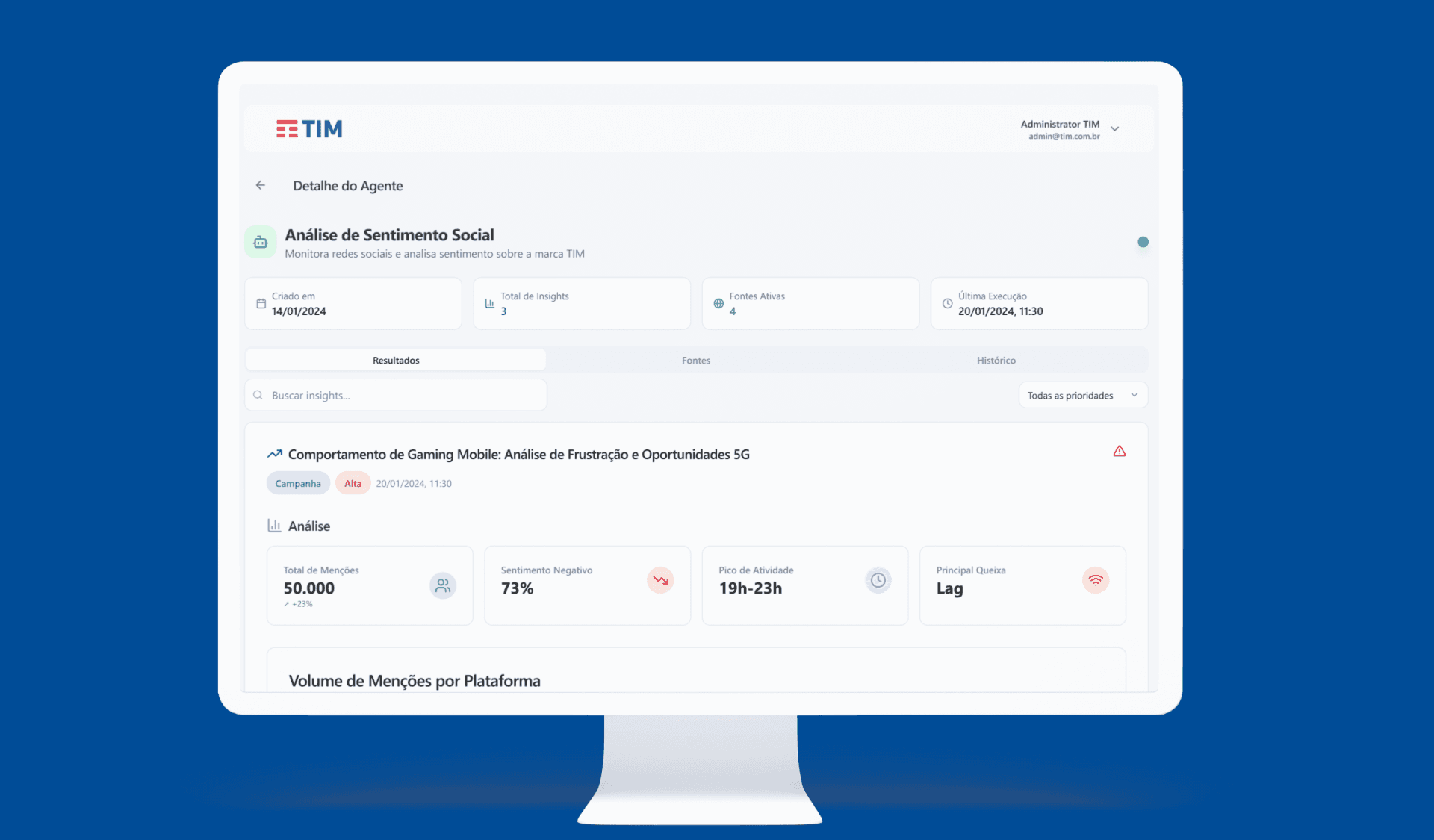
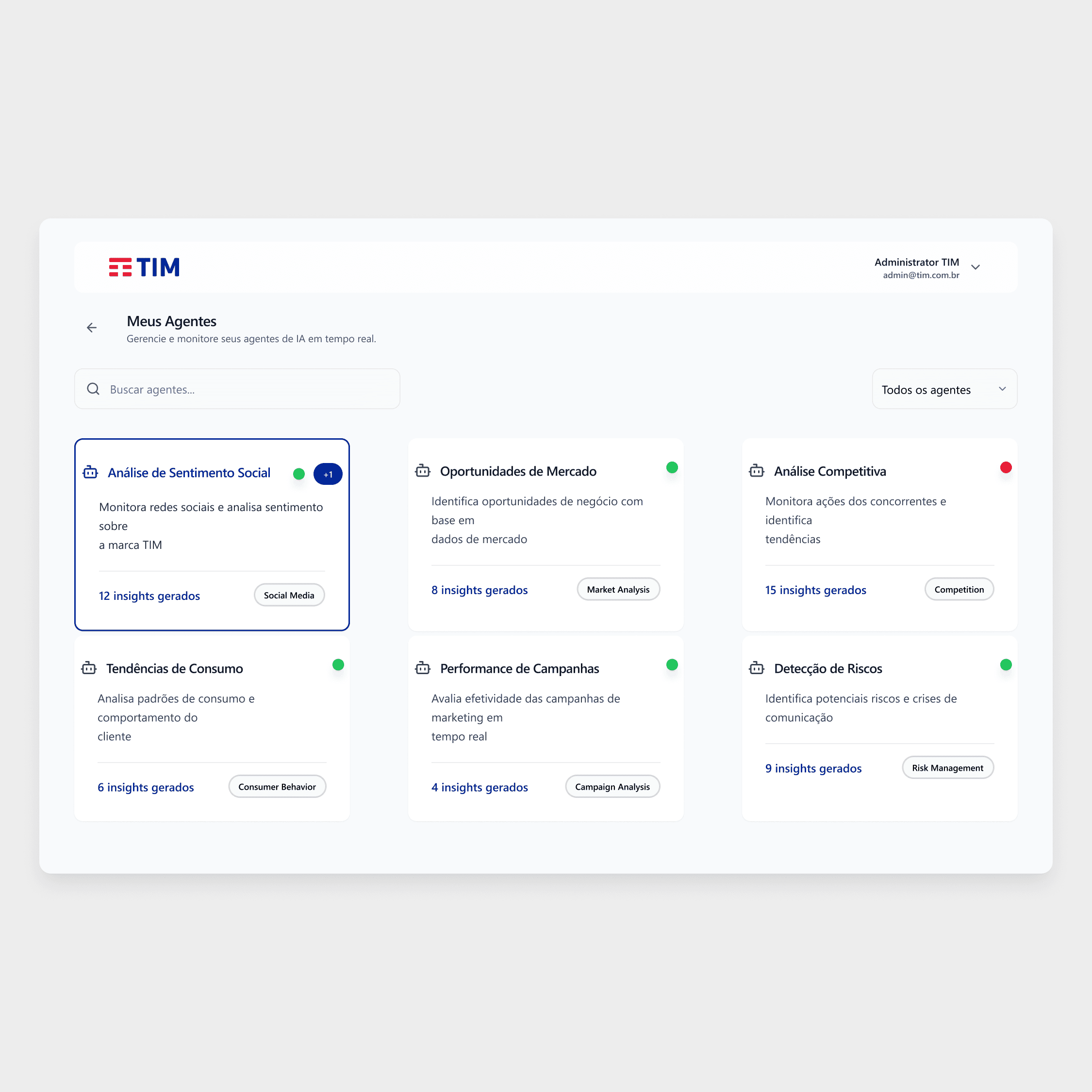
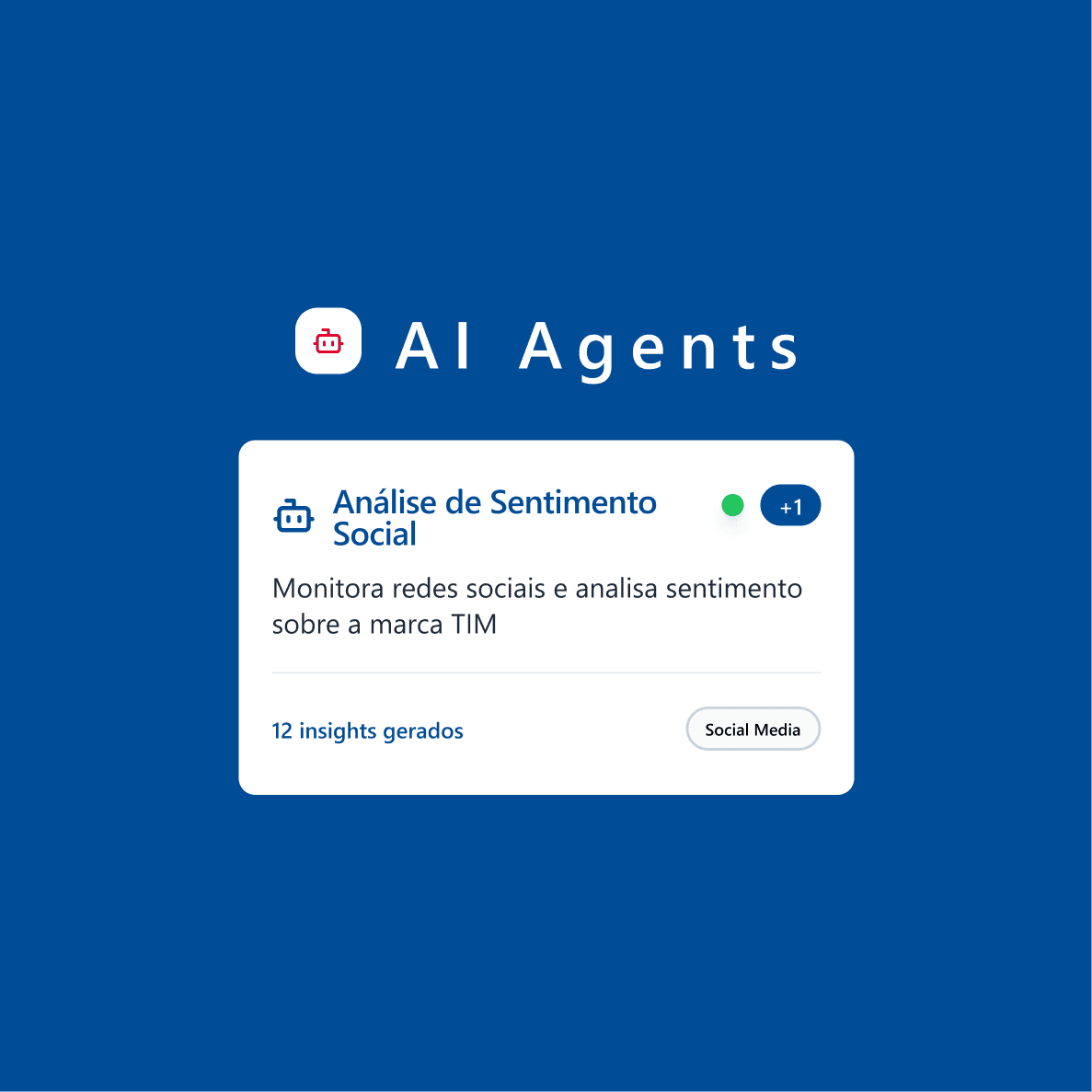
A manager for creating and configuring autonomous AI agents (e.g., "Monitor social sentiment for Brand X").
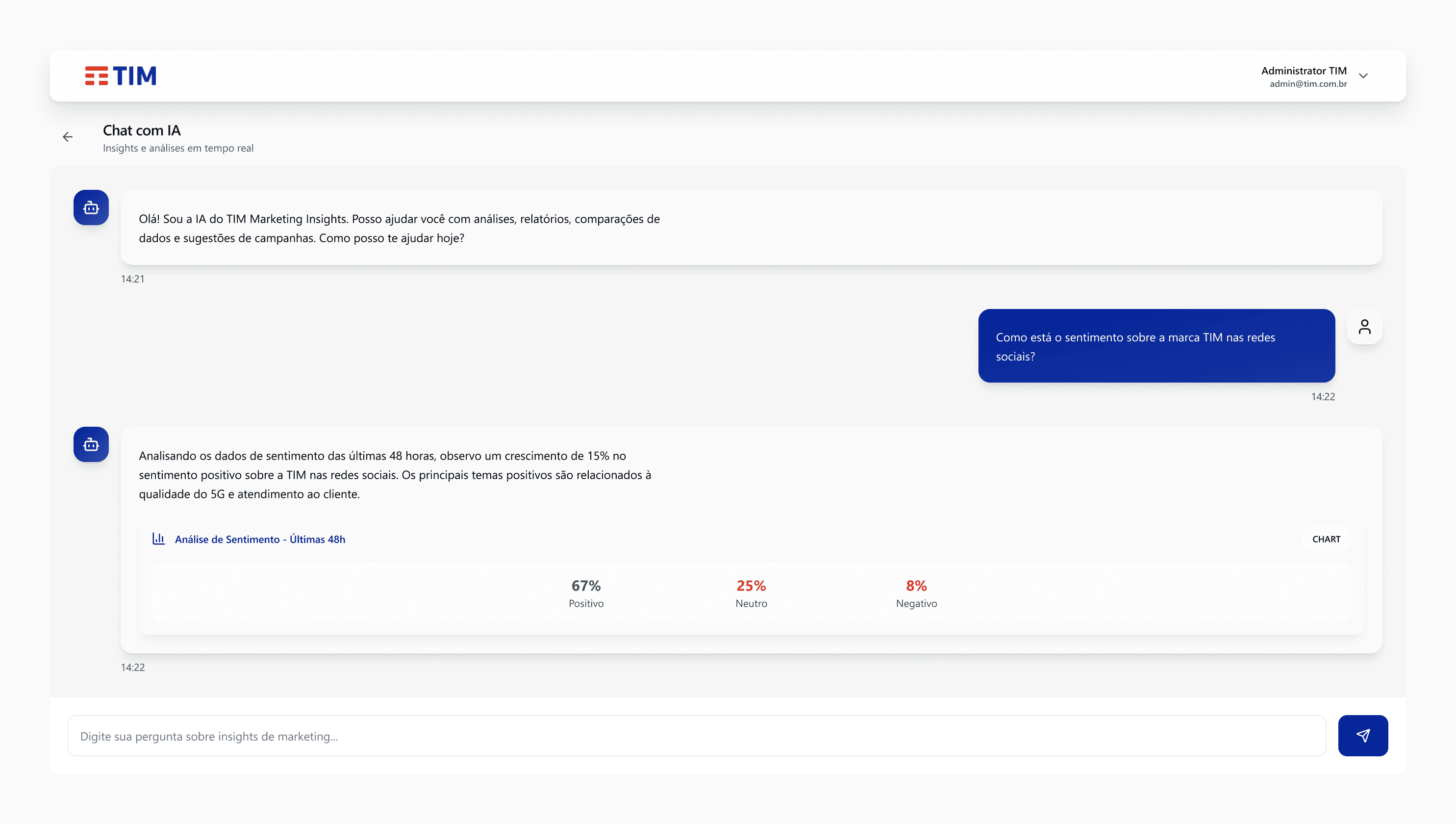
An AI-powered conversational chat for generating reports, comparing data, and receiving campaign suggestions.
Rapid Prototyping & Validation: To move beyond abstract concepts, I used Lovable to "vibe code" the Figma designs into a fully functional, high-fidelity web prototype. This wasn't just a static mockup; it was a 100% navigable simulation of the final product. This allowed users to interact with the dashboard, configure a mock AI agent, and test the conversational AI flow, providing tangible, experiential feedback that validated the product hypothesis.
results.
The primary outcome was a radical acceleration of the product validation cycle.
Speed to Validation: By using vibe coding to build a high-fidelity prototype, we validated the product hypothesis in a fraction of the time a traditional development cycle would have required. The client could see, touch, and interact with the solution, making the feedback loop immediate and highly actionable.
Tangible Alignment: The interactive prototype served as a more effective communication tool than any document or static wireframe. It brought stakeholders closer to the building process, fostering a shared understanding and stronger buy-in.
Next Steps: The project successfully moved from a hypothesis to a validated concept. Following the successful client demonstration and validation, the product is now in the negotiation phase for full-scale development.
Key Takeaway: This case demonstrates the power of combining strong product design fundamentals with modern development tools to de-risk innovation. It shows how a Product Engineer can bridge the gap between concept and reality, ensuring that the right solution is built before significant development resources are committed.